
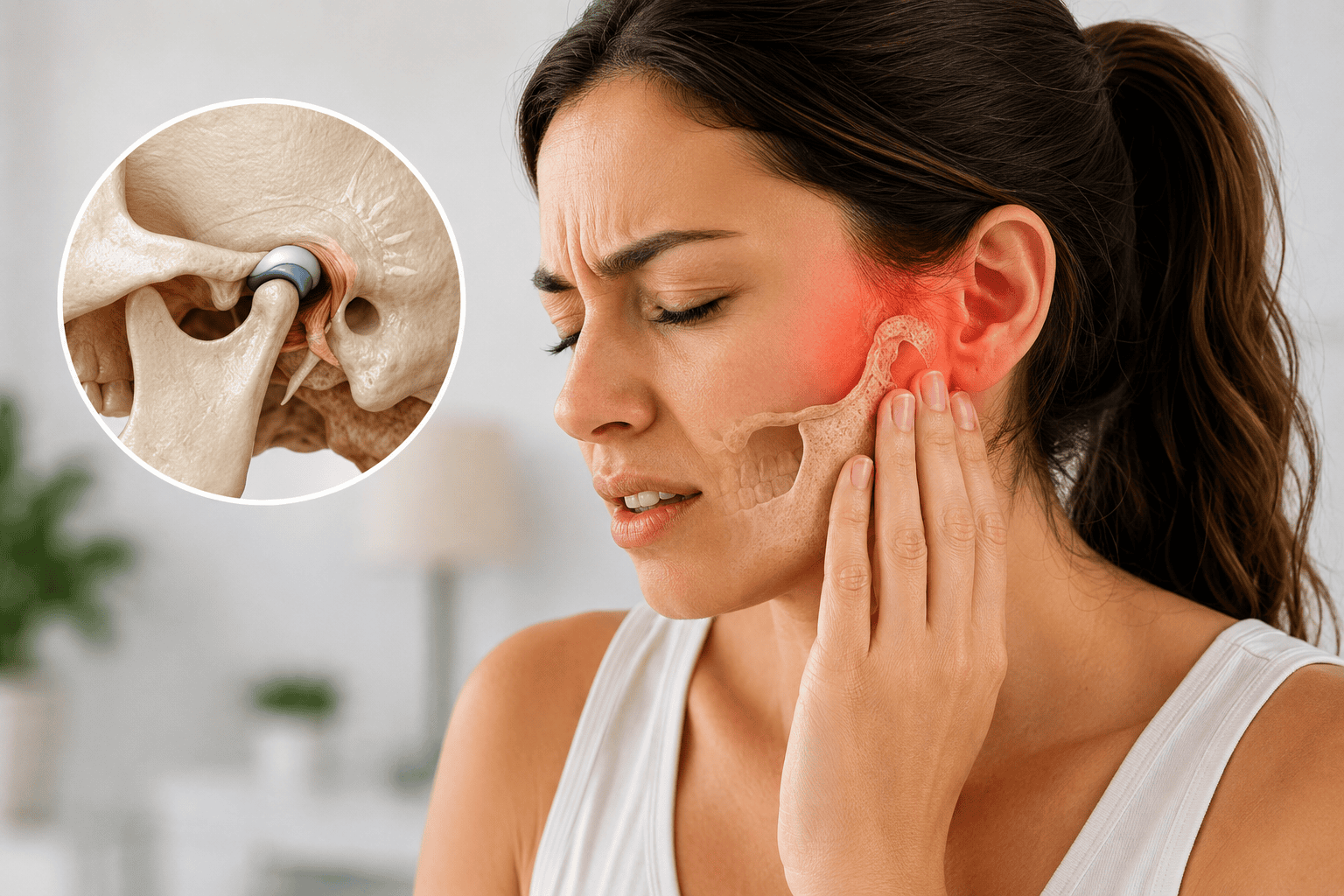

Your Jaw Keeps Clicking. Here’s What That Actually Means
I’ve spent about seventeen years working with people who have jaw and airway issues, and I’m a heavy clencher myself. I know what it’s like when your own jaw doesn’t cooperate, from both sides of the chair -both as a treating dentist and as a heavy clencher myself, I see the same thing every week in the clinic. If your jaw clicks, catches, feels tight, or gets sore when you chew, yawn, wake up, or talk, that’s usually a sign of a temporomandibular disorder, or TMD. It’s common, but it doesn’t settle down by guessing at solutions. It needs a proper look and a plan that fits the way your jaw actually moves.
Before looking at treatments, it’s vital to clarify what TMD actually is, and what it isn’t.
Dental “locked jaw” and “lockjaw” are not the same thing. Lockjaw is an old term for tetanus, a bacterial infection. If you’ve had a jaw injury and now have severe stiffness, fever, or trouble swallowing or breathing, that’s an emergency. Go to a hospital, not a dental website.
What we’re talking about here is TMD: problems with the jaw joint, the chewing muscles, or both.
Why Does My Jaw Click or Lock?

The jaw joint (the TMJ) has a small disc that lets it glide smoothly. When that disc shifts, or when the muscles around it are under strain, you get clicking, popping, stiffness, or in some cases the jaw catching in an open or closed position. Unless it follows acute trauma like a blow to the jaw or an accident, this is usually the result of a system that’s been under strain for a long time. It builds up gradually, not overnight.
The things we see most often contributing to it:
- Clenching or grinding, especially at night
- Sleep and breathing disorders
- A previous jaw injury
- Joint inflammation or arthritis
- Muscle tension, often stress related
- Nutrient deficiencies, particularly magnesium, iron, vitamin D, and omega-3 fatty acids, all of which play a role in muscle function and neuromuscular regulation
- A combination of the above
- That last point matters. TMD is rarely one clean cause. It’s usually two or three things stacking up, which is exactly why a proper assessment beats a generic fix.
Even a click with no pain is worth paying attention to. Clicking is your joint telling you something has changed, and getting it assessed early, before pain or restricted movement develops, gives you the most options.
How We Actually Assess It
There’s no single test for TMD. What we do is build a full picture: a physical examination of the joint and muscles, a look at your bite and wear patterns, and a conversation about when it happens, what makes it worse, and what else is going on for you (stress, sleep, grinding habits). If you can keep a diary of what happened, when, how you managed it, and how long it lasted, that’s genuinely useful. Where it’s warranted, we’ll use imaging (X-ray, MRI, or CT) to see what’s happening at the joint itself.
That’s the point of an assessment. Not to sell you an appliance on day one, but to work out what’s actually driving your symptoms before we touch anything. Learn more about how we assess TMD and airway issues
What Actually Helps
A conservative approach is still the right starting point, but here’s what mine actually involves: working out whether the issue is muscular, joint related, or both, then checking your range of motion. I’ll also make sure your gums and teeth are healthy enough to support whatever management plan we land on. Exercises are brought in specifically to ease pain, not add to it, and there’s no shortcut here. It takes patience and time.
Once we’ve worked out what’s driving it, treatment for most people starts conservative:
- Anti-inflammatory or pain relief medication (what’s appropriate depends on your medical history, so this is something we discuss individually)
- Rest and gentle jaw exercises
- Heat or cold therapy
- Softer foods while things settle
- Cutting back on clenching, gum chewing, or nail biting
If grinding or clenching is a significant factor, a properly fitted night guard or oral appliance can help protect the joint and muscles. It should be assessed and fitted by a dentist, not bought off a shelf, and it should never be designed to permanently change your bite. More on our appliance options
That’s worth repeating: permanently altering your bite or teeth is not a routine fix for TMD. The evidence doesn’t support it as a first line treatment, and done without proper reason it can make things worse. If anyone recommends reshaping your bite as a quick fix for jaw pain, get a second opinion.
When to Get It Looked At
My rule of thumb: book an assessment as soon as something feels off. A new click, a change in how your jaw moves. Don’t wait for pain to show up. It’s especially worth getting in if you’re noticing:
- Jaw locking open or closed
- Pain when chewing, yawning, or opening wide
- Trouble opening your mouth fully
- Clicking or popping, with or without pain
- Jaw stiffness that keeps coming back
- Headaches or facial pain alongside jaw symptoms
- Symptoms that are getting worse, not better
Waiting until it hurts means missing the easiest window to sort it out. Getting it assessed early tells you whether you need treatment or just some monitoring, and either answer is useful to have.
If your jaw suddenly locks severely, especially after an injury or with swelling, fever, or trouble breathing or swallowing, that’s an emergency department visit, not a dental one.
Book an Appointment
by calling us on 02 4647 4570
Our Location
Suite 3, 20 Somerset Ave Narellan NSW 2567