

Single-Visit Root Canal Treatment in Narellan
Most people told they need a root canal assume it means multiple appointments, a temporary filling in between, and a separate visit weeks later for the crown. At First Choice Dental, that’s rarely how it works.
For most cases, we complete the root canal and fit a permanent ceramic crown in a single appointment. You come in with a problem tooth. You leave with it treated and restored.

What makes a single-visit approach possible
The standard multi-visit model exists because most practices don’t have the technology or the clinical setup to do it any other way. We do.
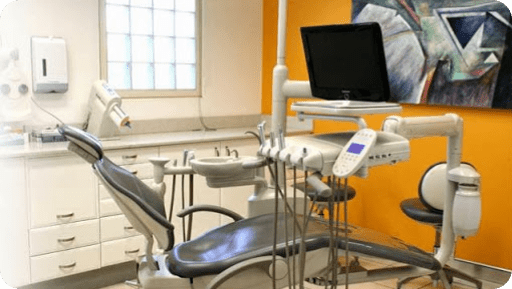
Everything needed for diagnosis, treatment, and restoration is in this practice:
A cone beam CT scanner for full 3D imaging of the root anatomy before we start. A dental operating microscope for precision throughout the procedure. A CEREC milling unit to design and mill your ceramic crown on-site. No lab. No temporary crown. No second appointment.
The clinical work is also different from the standard approach. We use ozonated water irrigation and laser disinfection alongside conventional canal preparation. Ozonated water reaches areas instruments can’t, disrupting bacterial biofilm throughout the canal system. The laser disinfects the canal walls. Combined with mechanical cleaning and sodium hypochlorite irrigation, this is a thorough disinfection protocol.
Once the canals are clean and shaped, we seal them with a bioceramic sealer. We’ve used bioceramics as our standard obturation material for over 10 years. The material is biocompatible, bonds to the dentinal walls, and doesn’t shrink on setting. It gives a durable, well-sealed result
Then the crown is milled and fitted. Same day
What the appointment looks like
The appointment is longer than a standard procedure. Set aside two to three hours depending on the tooth and its complexity.
The sequence is:
1. Assessment and imaging. We review your symptoms, take clinical photos, and use 3D CBCT imaging where indicated to map the root anatomy in full before treatment begins.
2. Anaesthesia and isolation. The tooth is fully numbed. A rubber dam is placed to isolate the operating field, keep it sterile, and prevent bacteria from re-entering the canal during treatment.
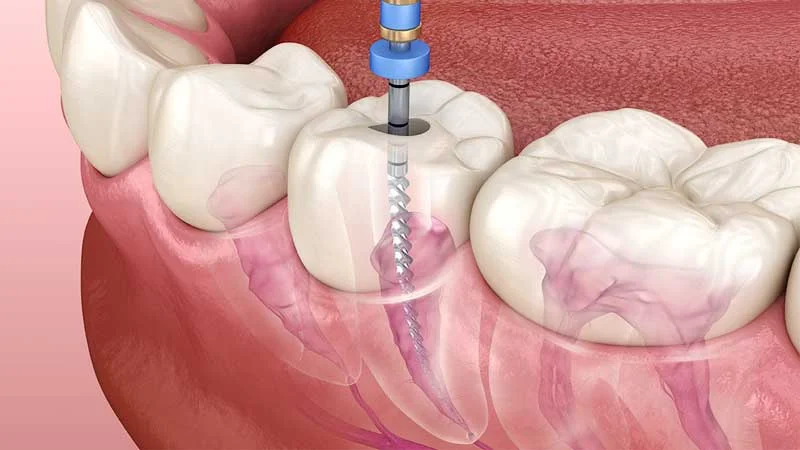
3. Canal preparation. Dr Henry works under microscope magnification to locate, instrument, and shape each canal. The microscope matters here. Root canals are narrow. Small or calcified canals are easy to miss without magnification.
4. Disinfection. The canals are irrigated with ozonated water and disinfected with a dental laser, in addition to conventional irrigants.
5. Obturation. The canals are sealed with bioceramic sealer.
6. Crown design and milling. The tooth is scanned digitally. The crown is designed and milled in the CEREC unit while you wait. It’s fitted and adjusted before you leave.
Useful Links
When single-visit treatment isn’t appropriate
Not every tooth is suitable and we’ll tell you at assessment if yours isn’t.
Cases that typically require staged treatment include: active acute infection with swelling or systemic signs, severely calcified canals, unusually complex root anatomy, or retreatment of a previously failed root canal. In those situations, completing in one visit isn’t clinically appropriate and we won’t do it just to tick a box.
If your case needs two visits, we’ll explain why. The protocol doesn’t change. The timeline does
Done here. No referral.
As your local dentist in Narellan, Dr Henry Mulla has been performing root canal treatment at First Choice Dental for over 17 years. We handle the vast majority of cases in-house, including complex ones. Referral to an endodontist happens when it’s genuinely the right call, not as a default.
For patients who’ve already been referred by another practice and want a second opinion, we’re happy to assess the case and give you a clear picture of what’s involved.
Call us on 02 4647 4570 or book online to arrange an assessment.
Frequently Asked Questions
Is single-visit root canal right for me?
If you’re looking for root canal treatment in Narellan, the only way to know is a clinical assessment with imaging. Many cases are suitable. Some aren’t. We’ll tell you clearly after we’ve looked at the tooth properly.
How long is the appointment?
Two to three hours for a root canal and same-day crown, depending on the tooth. Complex cases take longer. We’ll give you a realistic estimate before you commit.
Is it more expensive than a standard root canal?
The single-visit approach includes the ceramic crown in the same appointment. Compared to a root canal plus a separate lab-fabricated crown across two visits, the cost is comparable. The difference is your time.
What is a bioceramic sealer?
It’s the material we use to seal the root canals once they’ve been cleaned. Bioceramics are biocompatible, bond to the canal walls, and remain dimensionally stable after setting. Many practices still use older materials. We’ve used bioceramics as standard for over 10 years.
Why ozonated water? Isn't standard irrigation enough?
Standard irrigation with sodium hypochlorite is effective and we use it. Ozonated water is used alongside it as an adjunct. It has antimicrobial properties and reaches areas mechanical instruments can’t access. We use it because the evidence supports it as a useful addition, not as a replacement for the standard protocol.
What about the laser?
Same principle. Laser disinfection of the canal walls is used in addition to conventional methods, not instead of them. The combination gives us a more thorough disinfection than any single method alone.
Will it hurt?
The procedure is done under local anaesthetic. The area is fully numb before we start. Most patients find it far less uncomfortable than they expected. There’s typically some tenderness for a few days after as the area settles, managed with standard over-the-counter pain relief.
Do I need time off work?
Most patients go back to normal the next day. Some feel fine the same afternoon. A small number need a couple of days if there was significant infection pre-treatment.
What happens if it can't be completed in one visit?
We’ll place a medicated dressing and temporary restoration, and schedule the second appointment. This happens when clinical findings during treatment indicate staged care is the safer approach. You’ll be told why, not just handed another booking.